
An open letter to Mitchell Musack answering his response to my Iraqi pullout article.
Dear Mr. Musack,
I want to thank you for your time in responding to my article in the Fond du Lac Reporter of August 28. It is always an honor to have people carefully read, reflect on, and respond to something you've written. I also want to thank you for the respectful way you referred to me throughout your article as "Mr. Cross". No doubt, this lends to a greater respect of your opinion and a greater willingness to dialog than otherwise.
I think there are a few points that might help to clarify what I wrote. I want to assure you that by using the anecdote of student loans I was not in any way intending to trivialize this conflict or the invaluable contribution that persons like yourself make to our country and the freedoms we enjoy. Rather, I was using that analogy to make a complex issue more accessible and understandable for a broader range of people. This was merely an issue of writing style, not an adjudication on the immensity of the conflict we are in.
Secondly, the lack of support from our political system was the very thing I was hoping to address. People need to see that this should not be made a political issue, but they should take note that we are talking about people's lives. Certainly, the billion-plus dollars per day ought to be in our considerations as taxpayers in the U.S., but likewise, the lives of our soldiers, the Iraqi citizens and even insurgent fighters should be in our considerations. If Iraqi insurgents are utterly dominated with no effort made to change their frame of thinking, we will have lost this war. One need only see that the "victories" Israel enjoyed in 1949, 1967, 1973, and 2006 were no victories at all when Israel has been plagued by terrorism continually throughout those years. This present conflict will return on us tenfold in the generations to come if we don't take care to change people's hearts as well as their actions. Just as I wrote, the regular Iraqi citizens need ownership of their own security and sovereignty.
Finally, you cite the "surge plan" as being the final solution for Iraqi pullout. I think it is very important to stress that the surge is not a plan for pullout at all and it was never intended to be. The surge is an increase in troops by 25,000 which cannot be called a pullout by any stretch of the term. Rather, what I proposed works hand in hand with the surge. The surge is intended to finalize the conflict and I hope and pray that it does. However, even with the surge, a pullout plan is necessary which is just what I proposed. Note very clearly that I do not advocate "cold deadlines without regard to the situation" or "cutting off funding for our military" (both quotations from my article) which Congress has full authority to do since a declaration of war has not been made. You seem to imply that I advocate those ideas, but in reality, I am far from them.
The remainder of your response judges the merits of the current Iraqi conflict which my article did not address, so I will refrain from addressing that here. Even in that regard, however, I think you will find that a careful reading of what I've written in the article as well as here as well as in previous articles (http://mondaysinthemiddleeast.com) will reveal that perhaps I am not so far from your own point of view as you might think.
Thank you for your valuable service to our country. I am very grateful.
Sincerely,
Rev. David Cross
Friday, September 07, 2007


Tuesday, August 28, 2007
Apply principles of economics for slow withdrawal from Iraq
Here's the text of an article I recently had published in the Fond du Lac Reporter.
Apply principles of economics for slow withdrawal from Iraq
August 28, 2007
College expenses are rough. There's no getting around it. As an example, I went to a college that cost over $60,000 for four years, and graduated with $17,500 in debt. Oh yeah, that was almost 15 years ago.
That being said, I learned an important lesson in killing that debt during my first three years after graduation. Namely, work from the smallest loan to the largest. In my case, it seemed counterintuitive since my largest loan had the highest interest. Shouldn't I pay that first? No.
By knocking out the smallest loan first, I could apply all of those payments to my next largest loan and so on. Also, if I had trouble making minimum payments any month, it was much easier to manage when I had fewer minimum payments to make, so it made a lot of sense to reduce the number of loans I had as quickly as possible.
I'm very thankful for that simple lesson.
In a way, our country's involvement in Iraq is not unlike being buried in debt. We want to get out of it and we want to get out now, but how?
We feel like we've been there forever and we've paid an awful price. Haven't we paid enough?
Just as the bankers want to keep college students paying that interest, our enemies want to keep us in Iraq because it bolsters their cause, it makes them stronger. As long as our military is there, they've got a "bad guy" to blame for every problem.
In short, we need a way out, and it seems that an economics lesson in debt reduction can give us a clue. Cold deadlines without regard to the situation are not the answer. Cutting off funding for our military is akin to cutting off a knight's arm. Nope, pat answers will not do.
Instead, apply this clear principle: Knock out the easy stuff first. Look at the country of Iraq and focus intensively on the cities, states and regions that are showing the least problems. Aggressively train Iraqis to police those areas, then when they are fully trained, leave. Leave completely without returning. Make it clear to the Iraqis that any problems are now in their hands. It doesn't matter if skirmishes rise up or civil war breaks out. Those cities and regions go into full Iraqi control one by one from "easiest" to "hardest."
In this way, the U.S. military resources are freed up piece by piece to apply to the bigger problem areas, the "high-interest loans." It wouldn't be unrealistic to see a reduction in troops quickly rather than a demand for even more troops. Iraqis will have the sovereignty over their country that they want and need, Al Qaeda will be starved of the fame it has while the U.S. military is in the Middle East, and the U.S. will have its soldiers home.
The Iraqi people will even have an opportunity to regain a sense of honor in caring for their own country, something that has been largely undervalued in our relations with Arabs.
Of course, it's still going to be hard work and it will still take sacrifice, but progress will come in short order.
David Cross is the author of the book Mondays in the Middle East. A native of Fond du Lac, he has also lived in Bahrain, Oman, the United Arab Emirates and Egypt.
Mitchell Musack of Fond du Lac, Wisconsin wrote a response to this article which was published in the Fond du Lac Reporter.
Further, I wrote an answer to his response.
Tuesday, June 19, 2007


Wednesday, April 11, 2007
Google Book Search available
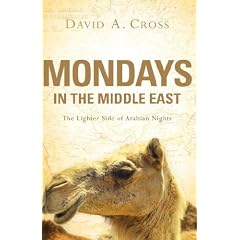 Mondays in the Middle East is now part of Google's book catalog. This means that people can read short excerpts before buying the book and it also means the book is searchable. So if you are looking for a particular story but you
just can't remember where it is, you can use http://books.google.com to search the book! Also, if you want to refer people to the book who might be interested in buying it, they can get a taste of what the stories are like.
Tuesday, March 20, 2007
Beware of Logic-Gate Foreign Policy
Originally published in the Fond du Lac Reporter March 18, 2007.
Fifteen years ago I learned a basic lesson of how computers work. They use simple commands such as
IF . . . THEN . . . ELSE
Though these commands are helpful with computers, I fear we are seeing this logic-gate approach applied to our relations with Iraq.
For example, New York Times columnist Thomas Friedman falls into this simplistic logic-gate approach. In a recent interview with Tom Ashbrook, he declared that the answer to fighting terrorism is in your car.
Oil is the problem, according to Friedman, and if we stop using oil, we will hit OPEC where it hurts most: oil. Then we can expect all of the countries of the Middle East to come running to the tables of democracy to humbly learn how to apply democracy in their own lands.
He cites as his example the country of Bahrain, which was the first Gulf country to discover oil, but has the smallest oil reserves and will be the first to run dry. Friedman reasons that this is why Bahrain was the first country to hold democratic elections and even the first Gulf country to see women vote and hold office.
Reducing our dependence on foreign oil is an excellent endeavor in itself, but to say that this will suddenly result in democracies popping up across the Middle East falls prey to the "IF-THEN-ELSE" line of thinking.
I lived in Bahrain when its king, Sheikh Hamad, took the throne after his father's death and I know the complexities of the situation firsthand. Bahrain has a Sunni Muslim government ruling over a large Shia majority. This alone made the political situation tense, but add that Sheikh Hamad was no friend of the Shia majority. When his father gave him a city to call by his name, he shut down all Shia mosques.
The streets were ablaze with rumors of rioting and revolt until Sheikh Hamad's first official act as king — he gave general amnesty to all of his father's political prisoners. He didn't stop there. He gave amnesty to exiles living abroad. He led the country through parliamentary elections in a sweeping overhaul of the country's governing system. He allowed women to vote and hold office for the first time in the country's history. He signed the first U.S. free trade agreement of any Gulf country.
What's the bottom line? Sheikh Hamad was acting for political survival, not because the oil was running out. Bahrain is now an offshore banking center, and its rulers have invested in education, health care and water desalination plants. The country has even made itself Asia's largest aluminum smelter. Bahrain won't be hurting for money even after the oil runs dry.
Look at neighboring Qatar, too. It recently built an enormous airport out in the middle of the desert. This empty air base successfully lured the United States forces for the base operations in the current Gulf conflict. Like Bahrain, Qatar opened free trade with the U.S. and instituted parliamentary elections.
Have they done this because they've reached the bottom of the barrel of oil money? Rather, they took all of these steps toward democracy after the world's third largest reserve of natural gas was discovered beneath its sands. In short, Qatar is exploding with wealth, yet it's becoming a key ally for the U.S.
Simply put, Friedman's conclusions are hastily drawn. Much deeper causes and effects are involved in transforming governments than this logic-gate approach to foreign policy. The lesson is, stand strong with our forces through the long process of transforming Iraq's government.
Let the process run its course, and when it does, let it go.
David Cross lives in Fond du Lac. Cross is the author of Mondays in the Middle East: The Lighter Side of Arabian Nights. He has lived and studied in Egypt, Bahrain, the United Arab Emirates and Oman.
Friday, February 16, 2007
Lowest Price for the Book

I want to make sure that I'm offering the lowest price for Mondays in the Middle East: The Lighter Side of Arabian Nights. The lowest I see right now is $12.08, but I'll beat it by selling for an even $12 ($9 for the book, and $3 for shipping). I can personally sign them, too. Enjoy some laughs!
Wednesday, February 14, 2007
Books for Troops is Taking Off
Several people have simply donated money to purchase books for troops in Iraq, but until now we haven't had a list of soldiers to send them to. We now have a list, so if you would like to buy books for our soldiers overseas, let me know! The easiest way to buy them is to use Paypal.com to send payment to revdacross(at)gmail.com . Just $11 will cover the book cost and the shipping for military PO boxes. Also, if you know names and addresses of soldiers, please send them my way! Right now we have more donations than names, so we should be able to get a book out pretty quickly.
Wednesday, January 24, 2007
KTIS Interview

This Monday I appeared on Kim Jeffries' program Along the Way on KTIS radio of St. Paul, Minnesota. The program was aired on
Duluth, MN - KDNI 90.5 FM
Fargo, ND - KFNW 1200 AM
Sioux Falls, SD - KNWC 1270 AM
Waterloo, IA - KNWS 1090 AM
Minneapolis, MN - KTIS 900 AM
Madison, WI - WNWC 1190 AM (Faith Talk 1190)The audio can be downloaded from Monday, January 22, 2007 on Kim Jeffries' site.
Kim and Kelly Lynn, the show's producer, were great hosts and made the show a lot of fun. They certainly enjoy their jobs!
Mondays Around the World
Mondays in the Middle East is making its way around the world! A few more international booksellers have picked it up. Most of the outlets are through Amazon sites, but others have grabbed on, too. Here's a list, just in case any of these sites might be closer to your physical location:
Amazon U.S.
Amazon U.K.
Amazon Germany
Germany
Amazon France
Germany
Italy
Amazon Japan
Amazon Canada
Monday, January 08, 2007
Gifts for Military Personnel
I heard again today of someone else who bought a copy of Mondays in the
Middle East for either a serviceman or the family of a serviceman, and
the wheels started churning. This has been one group of people I hadn't
really thought of who would be interested in the book, but many people
have let me know that they have bought copies for servicemen or their
families to put a little laughter and joy into their Middle Eastern
experience. As I think about it now, it makes a lot of sense, doesn't
it?
If you or your church would like to send books to servicemen overseas
or to their families here in the U.S., please let me know. I can sign
and send them directly. Books are $10 for paperback or $17 for hardcover. Shipping to military PO Boxes is the same price as shipping domestically, so that would be about $3 per book.
I'm proud of our military and I would be honored to have this simple
book be an encouragement to our soldiers and their families.
Subscribe to:
Posts (Atom)